Eight Bodies, and Not One of Them Printed
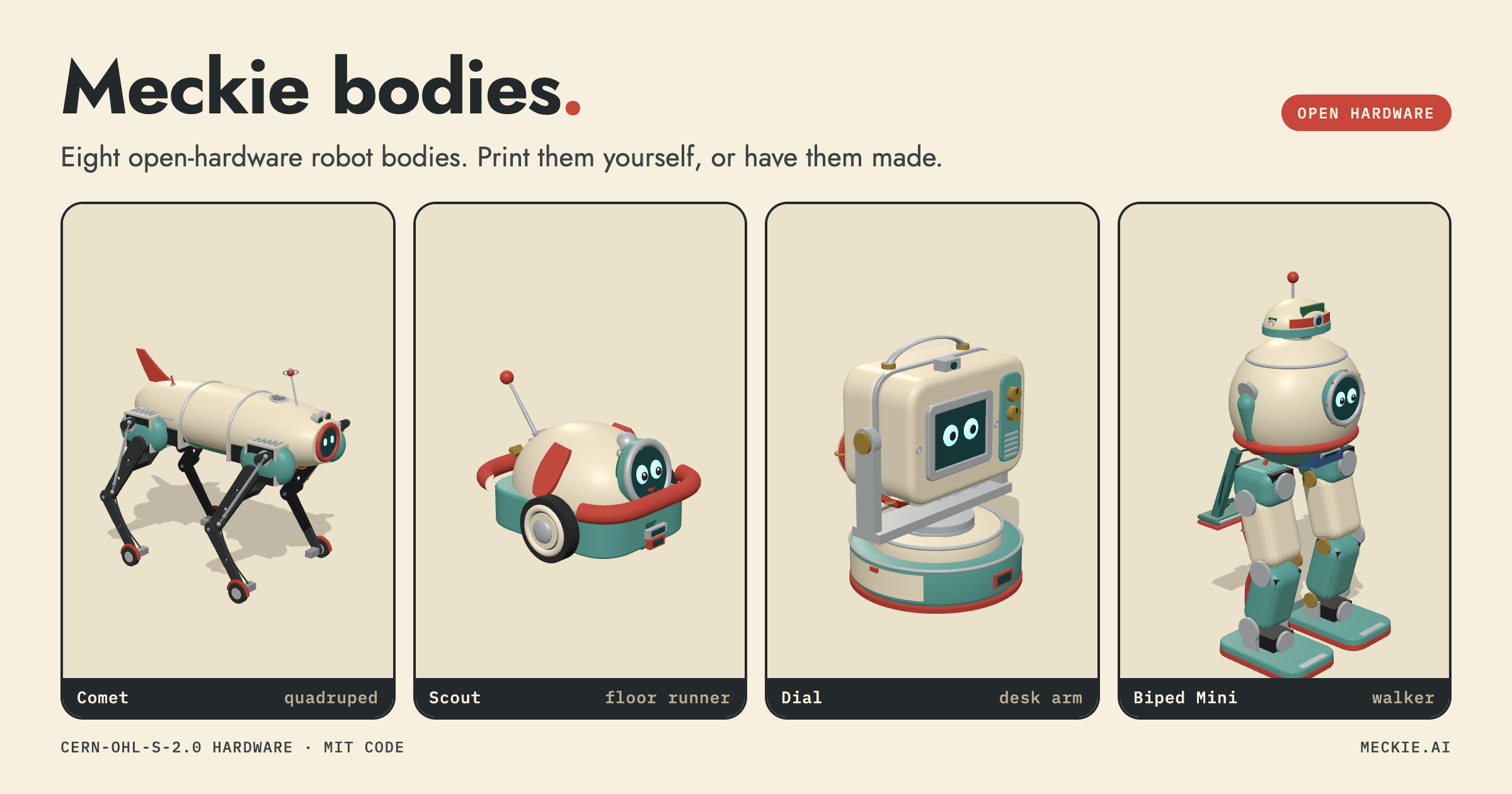
We published eight robot bodies. Print files, parts lists, wiring manifests, and a Hangar Bay template that flashes each one. Hardware is CERN-OHL-S-2.0, code is MIT. Build them, change them, sell them.
Not one of them has been printed.
That is not a teaser. The designs are finished and the files are real: 245 STLs, every one watertight, single shell, correctly named, and inside a 220 mm bed. 3,065 checks run against the catalog on every commit. The geometry is generated by code we can run in Node, so the print files and the pictures on the page come out of the same source and cannot disagree with each other.
What none of that proves is that a snap hook survives a hand.
What a validator can and cannot know
It knows every mesh is closed and every part fits the bed. It knows the manifests parse, the hashes match, and that a body which drives declares a forward obstacle sensor plus drop-off sensors front and rear. It knows the calibration wizard ends in a test proving the body parks itself when its brain goes away. It knows no joint is commanded past its declared range, and that a 6 V servo never ends up on a 12 V bus.
It does not know whether the hooks hold.
Where we think it breaks first
The snap features were drawn to stay under 2.5% strain. That is a PETG number. We print in PLA now, where the safe cantilever strain is nearer 1.5%, so every hook in the catalog is working harder than the geometry assumed. We think that is the first thing that breaks.
If you want to test the most load-bearing guess in the whole catalog, print Scout's upper and lower shell. Ninety cents of filament, one plate, both parts side by side. Close it. Open it. Tell us what happened.
A report that a hook snapped is worth more to us than a report that one held.
It prints on whatever you already own
PLA for everything rigid, TPU only where flex is the function: tyres, tracks, soles, feet, bumpers. No hardened nozzle, no dry box, no enclosure, no 260 °C hotend. Every part fits a 220 mm bed.
That was a decision, not an accident. These packs used to specify PETG shells over carbon-filled nylon structure, and nylon wants a hardened nozzle and a dry box. The cost difference between PETG and PLA across the whole catalog turned out to be about four dollars. The difference in who can print it is most people. A pack most people can only read is not open hardware in any useful sense.
The newest one is a dog
Comet is a quadruped that skate-walks on wheel feet. Twelve serial-bus servos, four gear motors, 83 printed pieces.
Its chassis deck was 250 mm long and the bed is 220. It could not be turned diagonally into fitting either, so the deck prints in two pieces now and bolts together on a stepped lap. There is no glue anywhere in this catalog. Everything screws into a heat-set insert or snaps.
We mention it because that is exactly the class of problem that only appears when somebody tries to make the thing. There are seven more bodies' worth of those we have not found yet.
Three ways to help
Print a part and tell us what broke. The hooks first. Then the heat-set bosses, which want a cooler iron in PLA than in PETG, around 180 to 200 °C, going in slowly. Then anything that needed supports where the brief said it would not.
Check our arithmetic. Every brief states its own print orientation, wall count and infill, and every bill of materials is a single-unit retail estimate from October 2026 that we have not re-checked against current listings. If a part number has moved or a price is wrong, that is a useful issue to file.
Contribute a body. A pack is one folder.
npm run new-body copies a working one and leaves you with
exactly one failing check: that your body is still an unmodified copy of Scout. That
failing check is the job, stated as a test. CI will tell you the rest of the standard
as you break it.
What we are not asking for
Money, or a signup. The files are up, the licence lets you sell what you make, and nothing on those pages takes a payment. A printer that handles this entire catalog costs about two hundred dollars, which is worth knowing before anyone pays us to print anything for them.
Bodies are open. Meckies are the product. We have said that before about somebody else's duck. It is easier to say when the bodies in question are ours.
The catalog is at meckie.ai/bodies. The repo is github.com/Meckie-AI/meckie-bodies.